
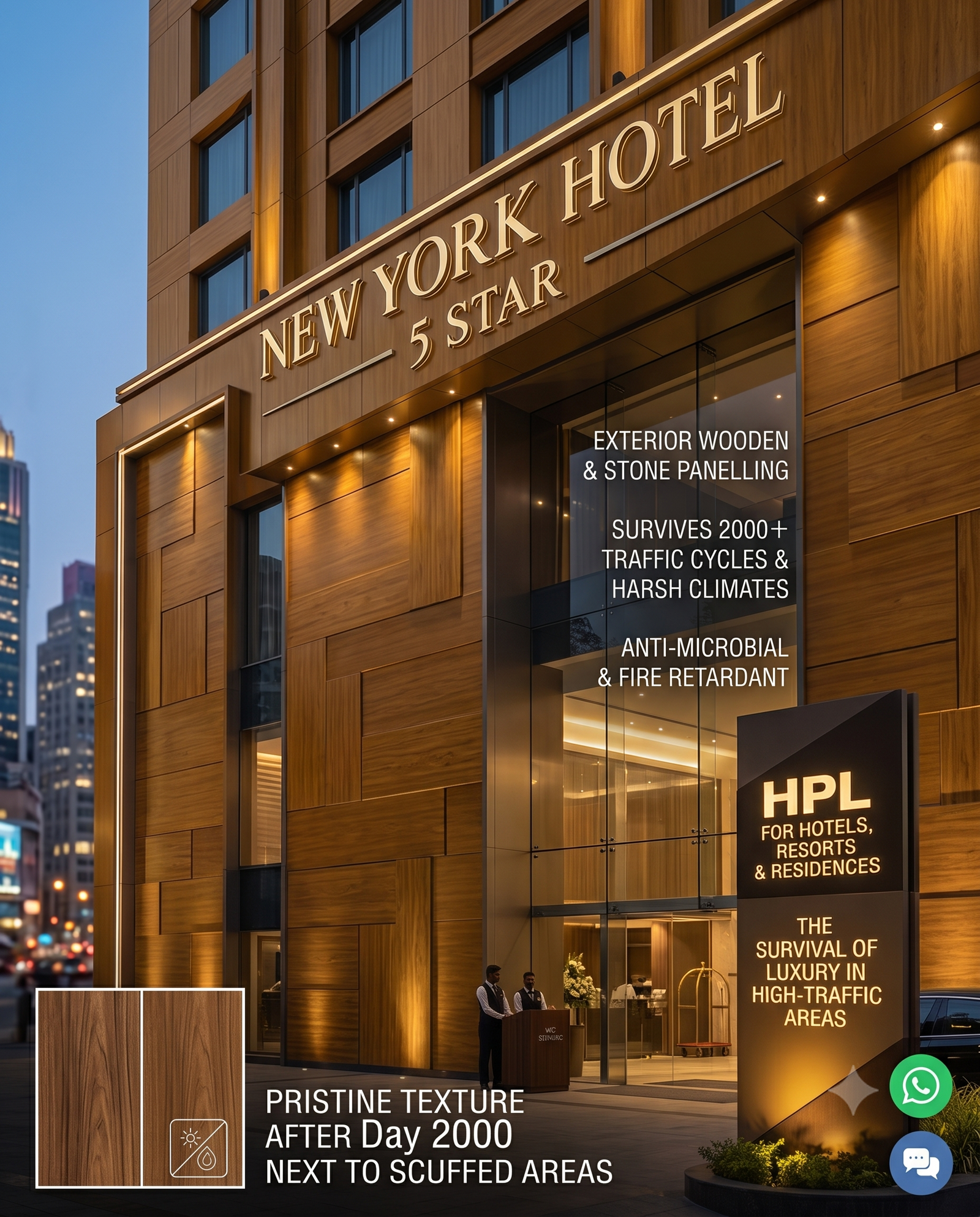
Quick answer: Hotels and restaurants use HPL for facades, corridor panelling, room feature walls, outdoor dining areas and furniture surfaces because it delivers a premium wood or stone appearance while resisting luggage impact, spills, humidity and constant cleaning that would ruin veneer or paint.
Table of Contents
- The Hospitality Problem
- Application Map for a Hotel
- Why It Works Commercially
- Design Notes for Hospitality Interiors
- Fire Requirements in Hospitality
- Frequently Asked Questions
The Hospitality Problem
A hotel corridor is walked by thousands of people dragging wheeled luggage. A restaurant wall is brushed by chairs and splashed by service. A resort facade faces sun, salt and monsoon while being photographed constantly for social media. And all of it has to look premium, because the finish quality is part of what the guest is paying for.
Veneer and paint deliver the look and fail the use. Tile and stone deliver durability and cost a fortune to install and alter. HPL sits in the middle, which is why hospitality groups increasingly default to it in high-contact zones.
Application Map for a Hotel
| Zone | What it faces | HPL application |
|---|---|---|
| Facade and porte-cochere | Sun, rain, arrival photography | Exterior grade rainscreen, 6-8mm |
| Lobby and reception | Footfall, luggage, first impressions | Feature walls, reception counter fronts |
| Corridors | Wheeled luggage, trolleys, daily cleaning | Dado or full-height panelling |
| Guest rooms | Suitcases, humidity, wear at headboard | Headboard walls, wardrobe fronts, minibar units |
| Bathrooms | Constant moisture and cleaning | 12mm compact for vanities and cubicles |
| Restaurant and bar | Spills, chair contact, grease | Wall panelling, counter fronts, table tops |
| Outdoor dining and poolside | UV, rain, chlorine, salt | Exterior grade cladding and furniture surfaces |
Why It Works Commercially
- Renovation downtime is revenue loss. A material that lasts through two guest-room refurbishment cycles takes rooms out of service less often.
- Damage is localised. A damaged HPL panel is unscrewed and replaced; damaged veneer usually means refinishing an entire wall.
- Cleaning is unrestricted. Housekeeping does not have to be careful with an HPL surface the way they must with polished veneer.
- Consistency across properties. A chain can specify the same decor across multiple locations and get repeatable results.
- Outdoor and indoor continuity. The same visual language can run from the porte-cochere to the lobby, which is difficult with timber.
Design Notes for Hospitality Interiors
- Use texture, not just colour. Embossed and synchronised wood textures photograph far better than flat prints, and hospitality lives on photographs.
- Combine HPL with genuine materials at touch points – a real timber handrail against an HPL wall gives authenticity where hands actually land.
- Plan for lighting. Grazing light along a textured panel is what makes a lobby look designed rather than merely finished.
- Vary panel proportions between zones so a long corridor does not read as a single repeating unit.
- Keep a documented panel schedule and spare stock for every property, because damage in hospitality is continuous and repair speed matters.
Fire Requirements in Hospitality
Hotels are sleeping accommodation, which places them among the most closely regulated occupancies for fire safety. Specify tested fire retardant grade for wall linings, corridors and facades, obtain the laboratory classification for the exact product supplied, and align the specification with the fire consultant’s strategy before ordering. Corridors matter especially, because they are the escape route.
Key Takeaways
- Hospitality needs a premium look that survives luggage, spills, humidity and constant cleaning.
- HPL runs continuously from facade to lobby to bathroom in one visual language.
- Damaged panels are replaced individually rather than refinished across a whole wall.
- Texture and lighting matter more than colour variety in hospitality photography.
- Sleeping accommodation demands tested fire retardant grade, especially in corridors.
Frequently Asked Questions
Why do hotels use HPL instead of veneer?
Veneer looks authentic but scratches, marks and needs careful cleaning and periodic polishing. HPL delivers a comparable appearance while surviving wheeled luggage, spills and daily housekeeping without refinishing.
Can HPL be used in hotel bathrooms?
Yes. 12mm compact laminate is used for vanity units, cubicles and wet-area panelling because it does not swell, delaminate or need sealing in constant moisture.
Is HPL suitable for outdoor restaurant areas?
Exterior-grade HPL is well suited to outdoor dining, poolside and terrace areas because it handles UV, rain, chlorine and salt without fading or absorbing water.
What fire grade does a hotel need?
Hotels are sleeping accommodation and usually require tested fire retardant grade for corridors, wall linings and facades. Obtain the laboratory classification for the exact product code and align it with the fire consultant’s strategy before ordering.
How quickly can damaged panels be replaced?
Individual panels can be unfastened and swapped without disturbing surrounding work, which is why maintaining spare stock from the original production batch is standard practice in hospitality properties.
Related Reading on HPL Maker
Talk to HPL Maker
HPL Maker is an Indian manufacturer of exterior-grade high pressure laminate with an industry-first live camera warranty of up to 25 years. Share your drawings or elevation photos and our team will suggest the right shade, thickness and fixing system for your project.
- Call / WhatsApp: +91 89824 90236
- Email: marketing@hplmaker.com
- Factory & Head Office: 124-126, Vrindavan Palace, Nipania Main Road, Vijay Nagar, Indore – 452010, Madhya Pradesh, India